PAUL • ROMANS • HOPE • CHRIST
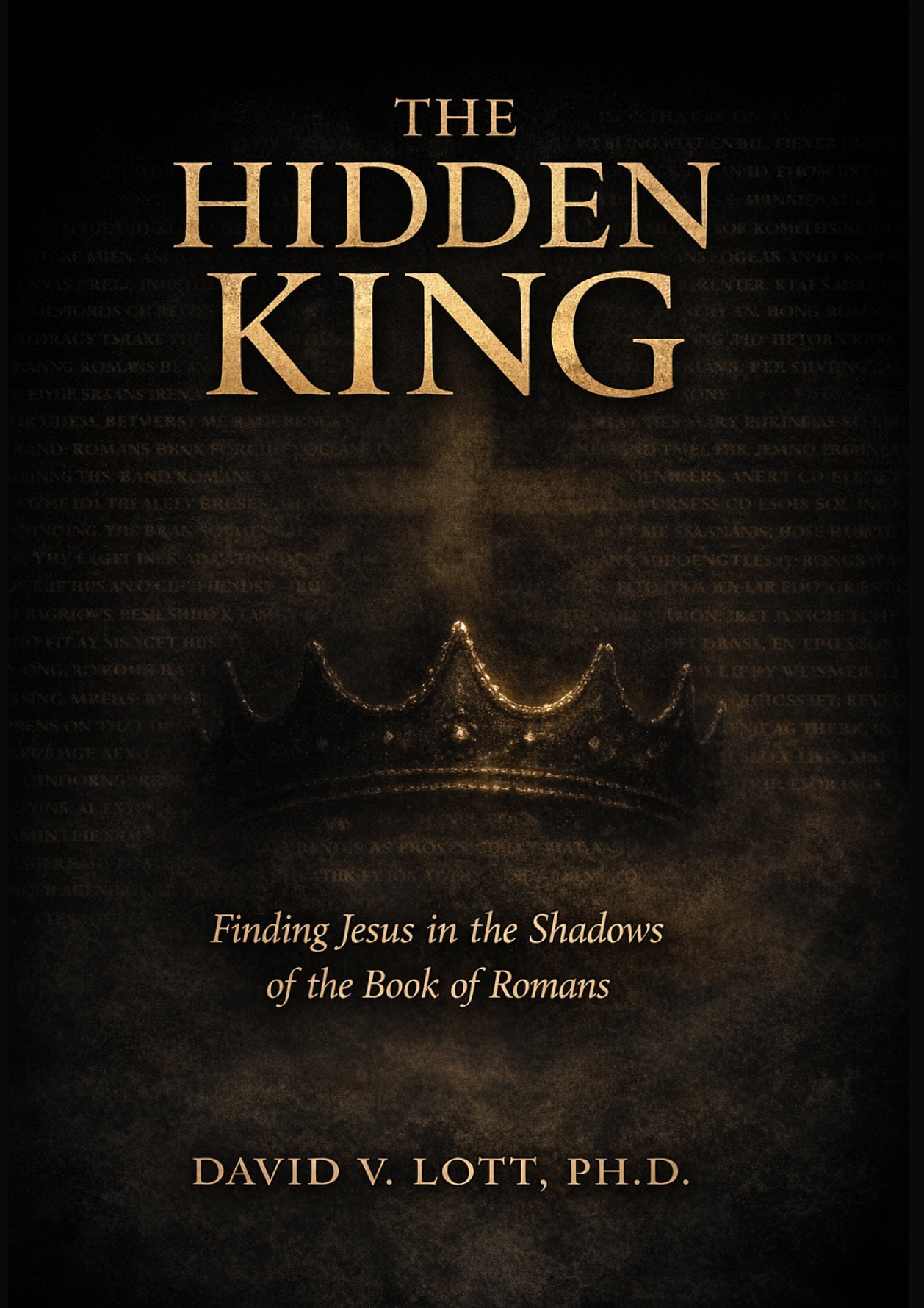
The Hidden King
Unveiling Hope in the Midst of Suffering: Paul’s Vision in Romans
What if Paul’s statement that “Hope does not disappoint” means considerably more than the reassurance that circumstances will eventually improve?
The Hidden King returns to Romans and reads Paul’s language within the rhetorical, cultural, and theological world in which his first hearers encountered it. Words such as Sin, Death, Law, Grace, Righteousness, and Hope do not simply sit passively within Paul’s argument. They act. They reign, accuse, enslave, govern, and accomplish things normally associated with persons and powers.
At the center of that drama stands Hope. Romans 5:5 does not merely describe Hope as something believers possess while waiting for a better future. Hope acts in the present. Following the argument developed from David V. Lott’s doctoral research, the book asks whether Paul is doing something far more Christological—allowing Jesus Christ Himself, the present and reigning King, to stand behind the personified language of Hope.
Once that possibility becomes visible, Romans 5–8 begins to look very different.
The Rhetorical World of Paul
When an Abstract Word Is Given a Face
Ancient readers were accustomed to rhetorical techniques that modern readers can easily overlook. One of those techniques was prosopopoeia—literally, the giving of a face or persona to someone or something not directly present.
Paul writes within that rhetorical world. Throughout Romans, abstractions behave with remarkable personal force. Sin enters, deceives, enslaves, and reigns. Death establishes dominion. Law speaks and prosecutes. Grace reigns. Righteousness governs. Hope does something particularly striking: Hope “does not shame.”
The Hidden King asks the reader to slow down when these abstractions begin acting like persons. Rather than assuming that Paul’s language is merely decorative, the book examines the grammar, historical context, canonical background, and larger Christological movement of Romans to ask whether a real person sometimes stands behind the abstract noun.
That question becomes especially important in Romans 5:5.
When an abstract noun begins doing what only a person can do, ask who may be standing behind the word.
The Old Realm
Sin, Death, and Law
Before Paul’s message of reconciliation can be fully appreciated, the powers holding humanity in captivity must be understood. Romans presents Sin and Death not merely as isolated theological concepts but as ruling realities. Sin enslaves. Death reigns. Law, although itself holy and good, becomes prosecutorial when it encounters fallen humanity under Sin.
The result is a realm characterized by condemnation, slavery, and Death.
Paul gives these realities extraordinary rhetorical force because the gospel is not merely an offer to help human beings behave somewhat better within the old order. Something much larger has occurred. Jesus Christ has entered the realm governed by these powers, absorbed their full assault in His death, and emerged through resurrection as the victorious King.
The reader therefore cannot fully appreciate Paul’s language of Grace, Righteousness, and Hope without first recognizing the captivity from which Christ delivers.
You cannot fully appreciate the rescue until you understand the captivity.
The Hinge of the Argument
What If Hope Is More Than an Expectation?
Romans 5:3–5 begins in suffering. Tribulation produces perseverance, perseverance produces proven character, and proven character produces Hope. Paul then makes the extraordinary statement that this Hope “does not shame.”
Modern readers commonly understand hope as an attitude directed toward the future. We hope something will happen. We hope circumstances will improve. We hope God’s promises will eventually be fulfilled.
Paul’s grammar invites a deeper question. The Hope of Romans 5:5 is not merely waiting passively for some future event. Hope is acting in the present, and the action attributed to Hope carries particular force within the honor-shame culture of Paul’s world.
The Hidden King develops the argument that Paul is using personification Christologically. The Hope who does not shame is ultimately not an abstraction but a Person. Christian Hope does not disappoint because Jesus Christ does not disappoint.
Hope does not disappoint because Christ does not disappoint.
Hearing Romans with First-Century Ears
“Does Not Shame” Meant More Than “Will Not Let You Down”
Romans was written into a culture in which honor and shame carried enormous social weight. Reputation, public standing, belonging, and one’s place within the community were deeply connected. Against that background, Paul’s assertion that Hope does not shame was far stronger than a gentle encouragement to remain optimistic.
The Christians in Rome confessed allegiance to a crucified Messiah. In the eyes of the surrounding world, crucifixion represented public humiliation and disgrace. Paul turns that verdict upside down. The cross that appeared to demonstrate Christ’s shame becomes, through resurrection and the Father’s vindication, the place where the world’s judgment is overturned.
The decisive question is therefore no longer what the surrounding culture thinks of those who have trusted Christ. The Father has already rendered His verdict concerning the Son, and those who belong to Christ participate in that vindication.
The apparent shame of the cross becomes the coronation of the King.
Rome Already Had a Hope
Paul Was Not Introducing the Word “Hope” Into an Empty Culture
Paul’s Gentile hearers did not encounter the language of hope without cultural associations. The Roman world already possessed its own public vocabulary of hope, embodied particularly in Spes, the Roman personification of hope, and intertwined with imperial expectations concerning the emperor, succession, stability, victory, and the continuation of Roman order.
Jewish hearers brought a different set of expectations. Their Hope was rooted in Israel’s Scriptures, the promises of God, the restoration of His people, and the expectation of a coming Davidic ruler and divine deliverance.
Paul writes to a church containing both worlds.
The Hidden King argues that his language does something remarkable. Rather than abandoning a culturally loaded word, Paul redirects it. Roman imperial hope, Jewish Messianic expectation, and the Christian proclamation of the crucified and risen Christ converge around a single question: Where can Hope finally be placed without being shamed?
Paul’s answer is not a political system, an emperor, an abstract virtue, or merely a future event.
His answer is Jesus Christ.
The New Realm
The Tyrants Are Not the Only Powers Paul Personifies
Paul’s personified language does not remain on the side of captivity. As the argument develops, Grace and Righteousness enter the drama and begin doing what the former powers had done: they exercise authority.
Grace reigns.
Righteousness governs toward life.
The language is significant because Paul is describing more than the cancellation of a penalty. A transfer of realm is taking place. The believer is no longer defined by Adam’s old dominion but by participation in Christ and the new order established through Him.
The Hidden King reads Grace and Righteousness as reconciliation agents whose activity ultimately points beyond themselves. Whose Grace is reigning? Whose Righteousness is governing? Who stands behind the Hope that does not shame?
The answer repeatedly leads to the same Person.
The reign of Grace is His reign. The freedom of Righteousness is His freedom. The Hope that does not shame is His presence.
The Two Federal Heads
Two Realms, Two Representatives, Two Outcomes
Romans 5 places Adam and Christ before the reader as two representative heads whose actions have consequences extending far beyond themselves. Through Adam come Sin, condemnation, and Death. Through Christ come righteousness, justification, Grace, and life.
This contrast explains why Paul’s gospel cannot finally be reduced to private spiritual improvement. The believer’s fundamental situation has changed because he has been transferred from one representative order into another.
The Christian life therefore begins with a reality already accomplished rather than a realm the believer must create through effort. The old powers may continue making demands and producing the appearance of authority, but their jurisdiction has been broken for the person who belongs to Christ.
The question is no longer simply, “How can I survive within Adam’s realm?”
The gospel announces that in Christ the believer belongs to another realm entirely.
Not Only Someday
What If We Keep Pushing Into the Future What Paul Says Is True Now?
Christians rightly look toward the future consummation of God’s promises: resurrection, the abolition of Death, the restoration of creation, and the visible reign of Christ. Yet The Hidden King argues that Paul’s language also insists upon realities already operating in the present.
Grace is reigning now. Righteousness is governing now. The Spirit has been poured into the believer’s heart. Hope is not shaming in some distant future tense; Paul’s language presents its activity as a present reality.
This does not eliminate the “not yet” of Christian Hope. It establishes the “already” from which the believer waits.
The final victory will not introduce a completely unrelated reality. It will unveil fully what Christ’s death and resurrection have already established in principle and what believers presently experience within His realm.
The Hidden King is not waiting to begin His reign. He is reigning now.
Hope in Tribulation
Suffering Is Real, but It No Longer Gets the Final Interpretation
Romans 5 does not introduce Hope by avoiding suffering. Paul begins with tribulation and traces what God produces through it: perseverance, proven character, and Hope.
This means Christian Hope is not denial. The believer does not need to pretend that suffering is painless, weakness is strength, or loss is insignificant. Instead, suffering is interpreted within a larger reality in which Christ is already present and the final outcome has already been secured.
The weakness experienced in the present therefore cannot be treated automatically as evidence of divine abandonment. Paul teaches believers to follow the chain—to recognize what God can produce through tribulation and to see that the movement ultimately returns them to Hope.
The circumstances may remain difficult. The interpretation of those circumstances has changed because the King is present within them.
Why Identify Hope with Christ?
The Argument Is Cumulative
Grammatical
Paul attributes present personal action to Hope.
Canonical
Israel’s Scriptures provide important antecedents for identifying the LORD as the Hope of His people.
Christological
Paul elsewhere uses hope-language in explicitly Christ-centered ways.
Contextual
Romans 5:5 stands within an argument saturated with the work and person of Jesus Christ.
Missional and Rhetorical
Paul’s language could speak simultaneously into Jewish expectation and the culturally saturated hope-language of the Roman world.
No single observation is intended to bear the entire argument. The Hidden King develops these lines of evidence cumulatively, asking whether together they provide a compelling reason to recognize Christ behind Paul’s personified Hope.
Questions the Book Explores
- 01
Why does Paul repeatedly give abstract realities such as Sin, Death, Grace, Righteousness, and Hope actions normally associated with persons?
- 02
What was prosopopoeia, and how might Paul’s original audience have recognized rhetorical signals modern readers often miss?
- 03
What does Romans 5:5 actually mean when it says that Hope “does not shame”?
- 04
How does the honor-shame culture of the Roman world deepen the force of Paul’s language?
- 05
What did “hope” mean to Jewish and Gentile believers living in first-century Rome?
- 06
Why might Paul’s language challenge Roman Spes and imperial claims concerning hope, peace, and security?
- 07
What evidence supports identifying the personified Hope of Romans 5:5 with Jesus Christ?
- 08
How do Grace and Righteousness function within the same personified drama?
- 09
What changes when Romans 5–8 is read as a movement between the old realm in Adam and the new realm established in Christ?
- 10
What does it mean to live today under the reign of a King whose final victory is still awaiting its complete visible manifestation?
The Biblical Foundation
The Hidden King in Romans
The Old Reign
- Romans 5:12–21
- Romans 6:6–14
- Romans 6:20–23
- Romans 7:7–13
Hope & the New Reign
- Romans 5:1–5
- Romans 5:15–21
- Romans 8:1–4
- Romans 8:18–25
The King Revealed
- Romans 8:31–39
- Romans 15:12–13
- Jeremiah 14:8
- Jeremiah 17:7
- 1 Timothy 1:1
Hope does not disappoint because Christ does not disappoint.
The Hidden King asks readers to reconsider one of Paul’s most familiar statements by recovering the rhetorical and cultural world in which it was first heard. When Hope is allowed to act as Paul describes it—presently, personally, and within a deeply Christological argument—the word begins pointing beyond an expectation concerning the future toward the One upon whom the future itself depends.
Christian Hope is ultimately secure not because believers can predict what happens next, but because their Hope is a Person whose reign has already begun.
The Scholarly Foundation
From Academic Research to an Accessible Exploration of Romans
The Hidden King grew from David V. Lott’s doctoral research into Paul’s personification of Hope in Romans 5:5. The dissertation developed the historical-rhetorical argument in academic form, examining the grammar, rhetorical conventions, cultural environment, canonical background, and Christological implications of Paul’s language.
The Hidden King brings that research into a different setting. It retains the central interpretive question but follows its implications through the broader argument of Romans in a form intended for pastors, teachers, serious Bible students, and readers who want to understand why Paul’s language of Hope matters for the Christian life.
The two works therefore belong together without being duplicates: one presents the scholarly case; the other invites a broader audience to follow the theological journey that emerges from it.
A Related Study
Defeating the Tyrants
The personified powers introduced in The Hidden King receive a more concentrated treatment in Defeating the Tyrants: Breaking the Reigns of Sin, Death, and Law. Where The Hidden King asks who stands behind Paul’s personified Hope, Defeating the Tyrants concentrates upon the hostile powers from whose dominion Christ delivers the believer.
Read together, the two books illuminate complementary sides of Paul’s argument: the old reign of captivity and the present reign of the King who has overcome it.
Explore the Argument
Scholarship, Biblical Theology, and Christian Life
Paul’s Personification of Hope
The Scholarly Foundation
The doctoral dissertation develops the historical-rhetorical case for understanding Paul’s personified Hope in Romans 5:5 Christologically.
Explore the Dissertation→The Hidden King
The Accessible Theological Study
Follow the argument beyond Romans 5:5 through Paul’s larger presentation of Sin, Death, Law, Grace, Righteousness, Hope, and the reigning Christ.
Current pageDefeating the Tyrants
The Believer’s Liberation
Examine more closely the powers of Sin, Death, and Law and what union with Christ means for their former claim upon the believer.
Explore the Book→About the Book
The Hidden King
Unveiling Hope in the Midst of Suffering: Paul’s Vision in Romans
David V. Lott, Ph.D.
The Hidden King brings historical context, ancient rhetoric, biblical theology, and Christology together in a fresh reading of Paul’s language in Romans. Building upon David V. Lott’s doctoral research into Romans 5:5, the book examines Paul’s personification of Sin, Death, Law, Grace, Righteousness, and especially Hope, asking whether these apparently abstract terms sometimes conceal something far more personal.
At the center of the study is the argument that Paul’s Hope is ultimately Christological. Against the competing hopes of the ancient world and in the midst of suffering, shame, and hostile powers, Paul directs his readers toward a King whose reign is already present. The Christian’s Hope does not rest merely in confidence that tomorrow will improve. It rests in Jesus Christ—the One who has defeated the old powers, established a new realm, and does not shame those who have entrusted themselves to Him.