Doctoral Research
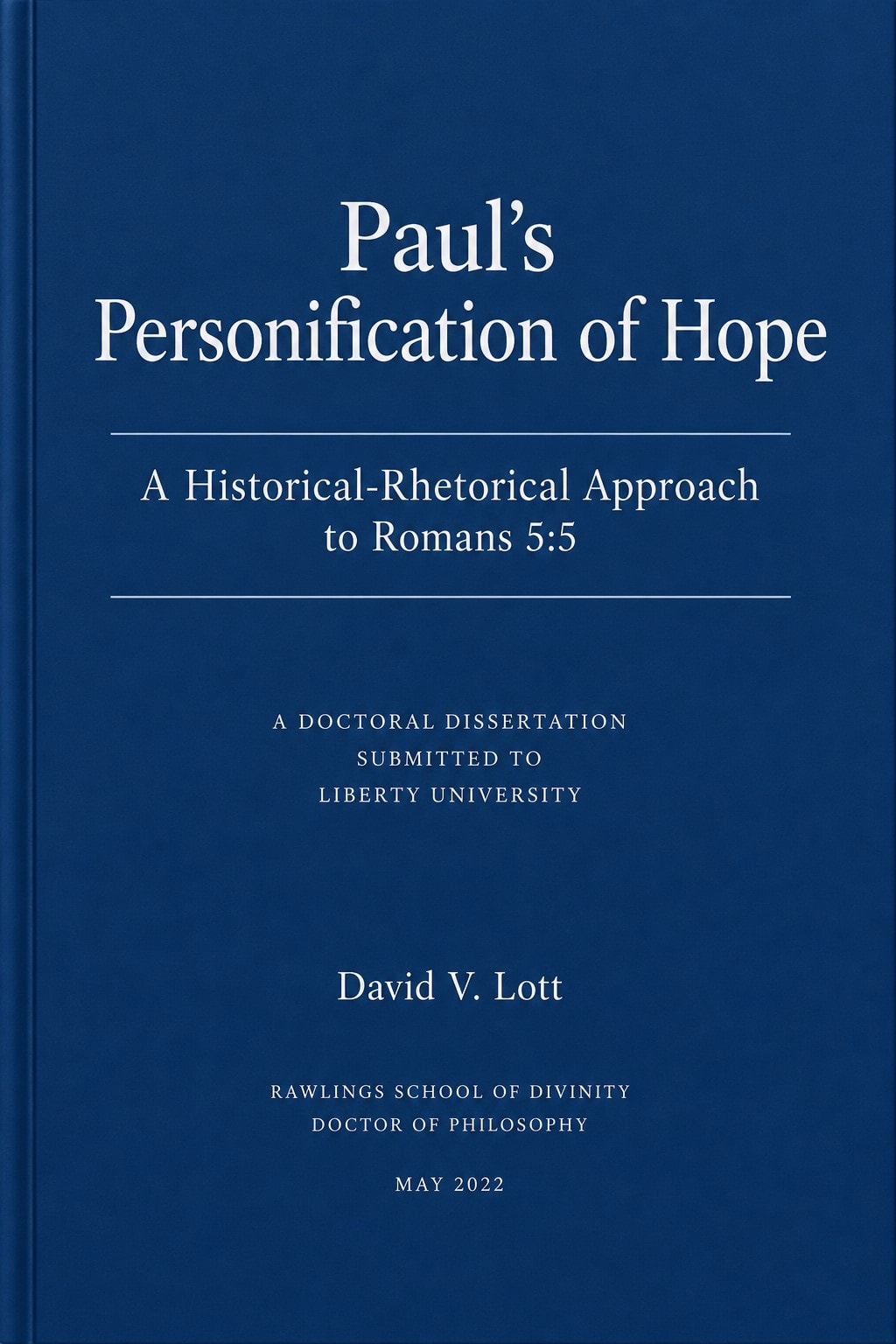
Paul's Personification of Hope
A Historical–Rhetorical Approach to Romans 5:5
What if Paul's "Hope" in Romans 5:5 is more than an abstract idea?
This dissertation examines Paul's remarkable use of personification in Romans 5–8 and argues that his declaration that "Hope does not shame" carries a profound Christological significance. Through historical, rhetorical, literary, and cultural analysis, the study explores whether Paul presents Hope ultimately in the person of Jesus Christ.
The Central Question
Is Hope an Idea—or a Person?
Romans 5:5 contains one of Paul's most familiar declarations: "Hope does not disappoint." But what if Paul intended his readers to hear something more?
Throughout Romans 5–8, Paul gives remarkable personality and power to abstract concepts. Sin reigns. Death reigns. Law speaks. Grace rules. Righteousness acts.
Against this extraordinary concentration of personification stands another figure—one easily overlooked:
Hope.
Paul's Personification of Hope investigates whether Paul's use of Hope should be understood within this same rhetorical world and whether the person ultimately standing behind that Hope is Jesus Christ Himself.
Hope does not merely point toward Christ. Hope is embodied in Christ.
The Historical Setting
One Gospel. Two Cultural Worlds.
The Jewish Audience
Jewish believers brought the promises, expectations, and messianic Hope of the Hebrew Scriptures into their understanding of the Gospel.
The Greco-Roman Audience
Gentile believers lived in a world shaped by Roman power, civic religion, mythology, imperial claims, and the Pax Romana.
The Christian Community
Paul addressed an emerging multi-ethnic church that needed a common theological foundation capable of transcending these different cultural worlds.
The dissertation argues that Paul's personification of Hope provided a rhetorical bridge capable of speaking to all three audiences—and that the bridge was ultimately Jesus Christ.
Romans 5–8
Paul Gives the Abstractions a Voice
Romans 5–8 contains an extraordinary concentration of personification. Paul portrays theological realities not merely as concepts but as actors within the drama of redemption.
Sin acts. Death reigns. Law speaks. Grace and Righteousness enter the conflict.
The dissertation asks why Hope has received comparatively little attention within this personified world.
A Historical–Rhetorical Approach
What Would Paul's First Audience Have Heard?
The study does not begin by asking only what Romans 5:5 means to the modern reader. It first asks what Paul's original Roman audience would have understood.
Ancient Rhetoric
Personification and prosopopoeia in the ancient world.
Pauline Personification
Paul's extensive personification of theological powers in Romans 5–8.
Jewish Hope
The Old Testament and Jewish expectation underlying Paul's language.
Greco-Roman Culture
Roman religion, imperial ideology, mythology, honor, and shame.
Audience Reception
How a mixed Jewish and Gentile Christian audience could have heard Paul's declaration.
Context matters. Audience matters. Rhetoric matters.
The Argument
"Paul personifies Hope in Romans 5:5 to present the Gospel of Jesus Christ to a divided, multi-ethnic church in a language capable of speaking to both Jew and Gentile."
— Paul's Personification of Hope
The dissertation proposes that Hope in Romans 5:5 serves a specifically Christological purpose. For the Jewish audience, Christ fulfills the Hope rooted in Israel's Scriptures. For the Gentile audience, Christ provides genuine Hope amid the competing religious and imperial claims of Rome. For the Christian community, Christ assures believers that their Hope will not result in shame.
Inside the Dissertation
A Study Across History, Rhetoric, and Theology
- Ancient Rhetorical Theory
- Paul's Use of Personification
- Sin, Death, Law, Grace & Righteousness
- The Personified Hope of Romans 5:5–11
- Jewish & Greco-Roman Audience Reception
- Honor and Shame in Roman Culture
- The Christological Identity of Hope
The Larger Theme
Hope Has a Face
The research undertaken in Paul's Personification of Hope became an important foundation for David V. Lott's continuing study of personification, Romans, Hope, and the person of Jesus Christ.
At the center is a theological conviction:
Christian Hope is not ultimately confidence in an outcome. Christian Hope rests in a Person—Jesus Christ.
The Original Dissertation
Read the Complete Study
Paul's Personification of Hope: A Historical–Rhetorical Approach to Romans 5:5 is available through Liberty University's Scholars Crossing institutional repository.
Read at Liberty University→