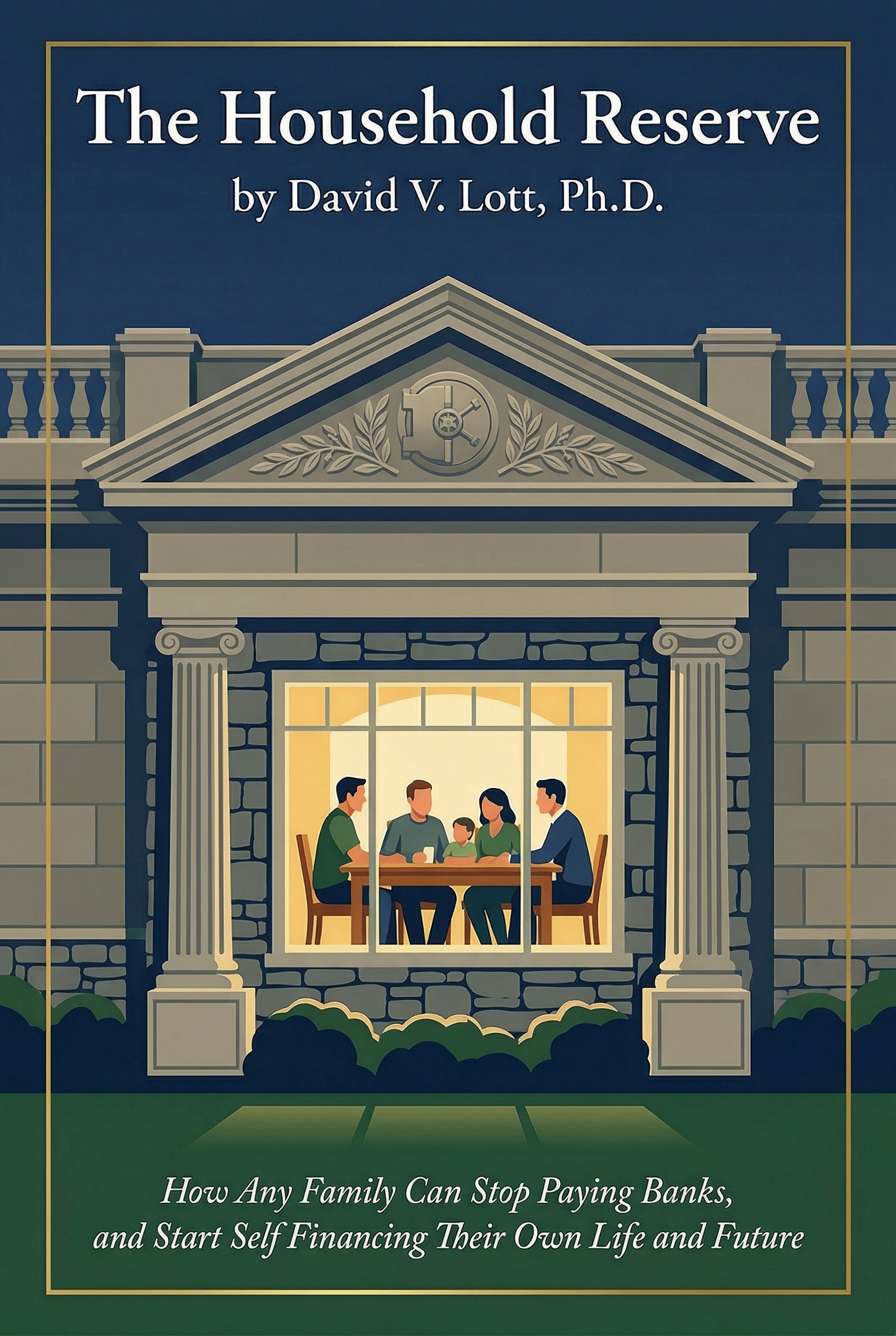
Personal Finance • Family Capital • Self-Financing
The Household Reserve
How Any Family Can Stop Paying Banks Forever and Start Self-Financing Their Own Life and Future
Most families think of themselves as consumers of financial services. They earn money, pay their living expenses, save what they can, and turn to banks, credit cards, dealerships, or other lenders when larger expenses arise. Interest then becomes another household expense, quietly transferring money the family earned into someone else's financial system.
The Household Reserve presents another approach. Rather than allowing money simply to pass through the household, the book develops a practical system for assigning every dollar a purpose, building financial reserves, protecting long-term growth, and gradually accumulating a pool of family capital that can eventually be used to finance many of the needs that once required outside borrowing.
The objective is not to become wealthy overnight. It is to build a household financial structure that becomes stronger, more resilient, and increasingly self-sufficient over time.
A Different Way to Think About Household Money
What If Your Income Became Capital Instead of Simply Passing Through Your Household?
The foundation of the Household Reserve begins with a change in perspective. Most household income arrives already spoken for. Mortgage or rent, utilities, groceries, insurance, transportation, subscriptions, debt payments, and everyday purchases consume the money, while whatever happens to remain may eventually become savings.
The problem is not necessarily irresponsibility. Many families work hard, pay their bills faithfully, and make reasonable financial decisions while still finding that very little permanent financial capacity is being created inside the household.
The Household Reserve asks the family to begin thinking like a builder rather than merely a consumer. Income is still used to support daily life, but a portion of it is deliberately captured and directed toward protection, long-term growth, and the creation of family capital. The question gradually changes from "What do we have left?" to "What job should each dollar perform before it is spent?"
Financial change begins when money stops drifting through the household and starts being directed with purpose.
The Household Reserve Structure
Four Accounts. Four Different Jobs. One Integrated System.
The Household Reserve is built around four financial pillars, each deliberately separated from the others because each has a different responsibility. This separation prevents everyday spending from consuming money intended for emergencies, long-term growth, or future self-financing.
Operating
Managing Daily Life
The Operating Account handles the ordinary expenses required to run the household: housing, utilities, groceries, transportation, insurance, and other predictable costs of daily life. Its purpose is stability and clarity rather than savings or investment.
Reserve
Absorbing the Unexpected
The Reserve Account provides the household's financial shock absorber. Instead of allowing an unexpected repair or expense automatically to become credit-card debt, the family gradually develops the capacity to absorb those events from its own resources.
Growth
Building the Future
The Growth Account protects money intended for long-term compounding and future financial security. Retirement and other long-term assets belong here rather than being repeatedly interrupted to solve short-term financial problems.
Family Bank
Building Financial Capacity
The Family Bank—or Opportunity Account—is the pool of capital the household deliberately builds so that appropriate future purchases and needs can increasingly be financed internally rather than through outside lenders.
The Operating Account handles today. The Reserve protects against disruption. The Growth Account builds tomorrow. The Family Bank creates options between the two.
Structure Before Growth
Good Intentions Are Not a Financial System
Families often attempt to accomplish several financial goals from a single checking or savings account. The same pool of money becomes an emergency fund, vacation fund, car fund, future investment account, and source for unexpected expenses. The result is predictable: the boundaries gradually disappear.
The Household Reserve uses separate accounts because money becomes easier to manage when its purpose is visible. A dollar assigned to long-term growth should not quietly become vacation money, and capital being accumulated for the Family Bank should not gradually disappear into ordinary household spending.
Separation is therefore not unnecessary complexity. It is the mechanism that protects the purpose of each part of the system and allows the family to see whether each financial objective is actually progressing.
Money Leaving the Household
Interest Is More Than an Expense—It Is Capital That No Longer Belongs to Your Family
Every time a household borrows externally, the principal pays for something the family needs or wants, while the interest compensates someone else for supplying the capital. Once paid, that interest permanently leaves the household.
One loan may not appear significant. Across years of credit-card balances, vehicle financing, personal loans, home repairs, educational expenses, and other borrowing, however, the cumulative amount can become substantial.
The Household Reserve does not assume that all outside borrowing can disappear immediately. Instead, it provides a process through which the family gradually builds enough internal capacity to reduce its dependence upon external lenders. As that capacity increases, money that once left the household as interest can increasingly remain within the family's own financial system.
The long-term objective is not merely to borrow less. It is to build enough family capital that outside borrowing becomes less necessary.
Becoming Your Own Source of Capital
What If the Interest Came Back to Your Family?
The Family Bank is one of the distinguishing features of the Household Reserve. The concept begins simply: accumulate capital deliberately, protect it from casual spending, and eventually use a portion of that capital to finance appropriate family needs that might otherwise require an outside loan.
These transactions are not treated as casual withdrawals. The book advocates documenting internal loans, establishing repayment terms, charging a modest interest rate, and returning both principal and interest to the Family Bank. The discipline matters because the objective is not simply to spend accumulated savings; it is to create a renewable pool of capital.
When repayments return to the account, the principal becomes available again and the interest increases the family's capital rather than an outside lender's. Repeated over time, the Family Bank can grow from a small account into a meaningful source of household financial flexibility.
The money is not simply spent. It is recycled through the household.
The Reserve Account
An Unexpected Expense Should Not Have to Become Long-Term Debt
Car repairs, medical deductibles, home maintenance, broken appliances, and other unexpected expenses are part of ordinary life. The financial damage often occurs not because the expense exists, but because the household has no designated capital available when it arrives.
Without a reserve, an immediate problem can become a much longer financial obligation. A repair placed on a high-interest credit card may continue consuming household income months after the original problem has been solved.
The Reserve Account changes the sequence. The family absorbs the expense from money specifically accumulated for disruption and then rebuilds the reserve. The expense remains inconvenient, but it does not automatically become another source of compounding debt.
The Stabilization Phase
You Do Not Need a Perfect Financial Starting Point
The Household Reserve is not written only for families beginning with surplus cash and no debt. Many households begin while carrying credit-card balances, vehicle loans, and other obligations that already consume part of their monthly income.
The book therefore develops a stabilization process for identifying the debts doing the greatest financial damage and systematically reducing them while still beginning the habits that will eventually support the Household Reserve.
High-interest debt receives particular attention because it can work directly against the family's effort to accumulate capital. At the same time, the process recognizes the importance of beginning the new financial behavior rather than waiting indefinitely for perfect circumstances.
The goal is to move deliberately from stabilization into accumulation as expensive debt is eliminated and the cash flow previously devoted to those payments becomes available for building the family's own financial system.
Start Where You Are
The First Capital May Already Be Moving Through Your Household
Building a Household Reserve does not begin with the assumption that a family has thousands of dollars sitting unused. The first task is to understand where current income is actually going.
Tracking household spending can reveal subscriptions, eating out, unplanned purchases, and other expenses that individually appear insignificant but collectively consume meaningful monthly cash flow. The objective is not deprivation for its own sake. It is to identify money already passing through the household that could be redirected toward creating permanent financial capacity.
Even a modest amount, consistently captured and automatically transferred before it can be absorbed into ordinary spending, begins the process. The initial balance may be small, but the more important achievement is establishing the habit of allocating money intentionally before lifestyle has an opportunity to claim it.
Building the System Into Daily Life
A Financial System Works Best When It Does Not Depend Upon Remembering
One of the practical principles throughout The Household Reserve is automation. Contributions made only when the month feels comfortable tend to become inconsistent because ordinary life continually produces another use for available money.
Automatic transfers reverse that sequence. The family decides in advance how much money belongs to each objective and moves it when income arrives rather than waiting to see what remains.
As income increases, contributions can increase as well. Over time, a process that initially required conscious discipline becomes part of the normal financial operation of the household.
More Than Money
Your Children Are Learning a Financial System Whether You Intend to Teach One or Not
Children observe how their families respond to money long before they understand financial terminology. They see whether unexpected expenses create panic, whether borrowing is automatic, whether saving has a purpose, and whether financial decisions are deliberate or reactive.
A functioning Household Reserve provides another model. Younger family members can observe capital being accumulated, needs being anticipated, internal loans being documented and repaid, and interest remaining within the family rather than continually flowing outward.
The system therefore has a generational dimension. The objective is not simply to leave descendants money, but to give them a working example of how a household can manage, protect, grow, and deploy financial resources responsibly.
The Power of Consistency
The System Is Designed to Become More Useful as the Years Pass
The early years of a Household Reserve can feel unimpressive because the balances are still developing. Yet each contribution adds capital, every repaid internal loan restores funds for future use, and interest returned to the Family Bank increases the amount available for the next opportunity.
As the Reserve becomes fully funded, emergencies become less disruptive. As the Family Bank grows, larger expenses can increasingly be handled internally. As expensive external debt disappears, more household cash flow becomes available for accumulation and long-term growth.
Eventually, the most important change may not be a particular account balance. It is the household's financial identity. Instead of automatically asking where it can borrow the money it needs, the family increasingly asks whether it can fund the need itself.
The Household Reserve is not a quick financial technique. It is a system whose usefulness grows through consistency and time.
One System • Multiple Purposes
How the Four Pillars Work Together
Income Arrives
Operating
Fund the predictable cost of living.
Reserve
Build protection against disruption.
Growth
Protect long-term compounding.
Family Bank
Accumulate capital for future self-financing.
Recycle Capital
Repay internal loans so principal and interest return to the family system.
The strength of the Household Reserve comes from the interaction of its parts. Daily expenses have a home, emergencies no longer need to raid long-term assets, retirement capital can remain focused upon the future, and the Family Bank can gradually develop into a renewable source of capital for appropriate household needs.
Questions the Book Explores
Building a Household That Can Finance More of Its Own Future
- 01
Where is our household money actually going each month, and how much of it is drifting without a deliberate purpose?
- 02
How much money are we currently transferring to outside lenders through interest?
- 03
How can separate Operating, Reserve, Growth, and Family Bank accounts create greater financial clarity?
- 04
How large should a household reserve become before it can effectively absorb financial disruptions?
- 05
How can a family begin building capital while simultaneously dealing with existing high-interest debt?
- 06
How should internal family loans be documented and repaid so that the Family Bank remains a genuine financial system rather than becoming another spending account?
- 07
How can increased income and occasional windfalls accelerate the Household Reserve without simply increasing lifestyle spending?
- 08
What could ten years of consistent contributions, recycled interest, disciplined borrowing, and long-term compounding mean for an ordinary household?
The Essence of the Book
"The goal is to move from a household where money simply passes through to a household where money is deliberately protected, grown, and put back to work for the family."
— The Household Reserve
The Household Reserve is ultimately about creating financial capacity. The system begins with ordinary income and deliberate structure, then uses separation, automation, reserves, long-term growth, and disciplined internal financing to help the household become progressively less dependent upon outside debt. The transformation does not occur because the family suddenly earns an extraordinary income. It occurs because the money already entering the household is given direction and allowed to build upon itself over time.
Continue Exploring
From Household Financial Strength to Generational Stewardship
The Household Reserve concentrates on building financial capacity within the household today. Two companion books widen the perspective from present financial structure to the larger question of what happens when resources, responsibility, and family purpose eventually move from one generation to another.


Building Something Worth Passing Forward
Financial Capacity Is Only One Part of a Family Legacy
The principles developed in The Household Reserve naturally lead to a larger generational question. Once a family learns to manage resources intentionally, build capital, reduce dependence upon outside debt, and create greater financial resilience, what should eventually happen to the habits, knowledge, resources, and opportunities that have been created?
The Family Legacy Handbook extends that conversation beyond financial structure into faith, stewardship, family purpose, relationships, and generational responsibility. Breaking the Shirtsleeve Curse then addresses the challenge of transferring responsibility without allowing inherited resources to undermine the character and discipline necessary to steward them.
Together, the three books trace a progression from building financial capacity, to defining family legacy, to preparing the next generation to carry it forward.
About the Book
The Household Reserve
How Any Family Can Stop Paying Banks Forever and Start Self-Financing Their Own Life and Future
David V. Lott, Ph.D.
The Household Reserve presents a practical system for helping ordinary families take greater control of the money already moving through their household. Built around four distinct financial pillars—Operating, Reserve, Growth, and the Family Bank—the book shows how families can organize cash flow, prepare for unexpected expenses, protect long-term growth, address damaging debt, and gradually accumulate capital for future self-financing. The objective is not a shortcut to wealth, but a disciplined structure through which a household can become increasingly resilient, reduce its dependence upon external lenders, retain more of the money it earns, and build financial capacity that can strengthen both the present family and the generations that follow.
View The Household Reserve on Amazon→This book is educational in nature and is not individualized financial, investment, tax, or legal advice. Readers should consider their own circumstances and consult appropriate professionals when necessary.